Discover how AI is reshaping hiring, organizational design, and startup scaling. Learn why founders should hire for capabilities, redesign workflows, and rethink growth.
For a long time, scaling a startup followed a relatively simple equation: more customers created more work, and more work required more people. As revenue grew, founders hired more engineers, salespeople, marketers, customer success managers, and operations specialists. Headcount became one of the clearest indicators of a company’s growth because people were the primary way to increase capacity. Every new hire expanded what the organization could build, sell, or support.
As AI takes over more repetitive and execution-heavy tasks, individual employees can accomplish significantly more than before, allowing companies to grow without increasing headcount at the same pace. But this doesn’t mean we’re heading toward a future without jobs. To see why, we first need to understand the relationship between growth and headcount. AI introduces a new source of capacity, forcing founders to rethink one of the oldest assumptions in company building.
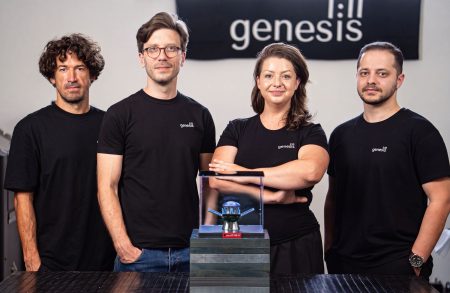
This trend is already changing how startup founders think about scaling. We asked our portfolio companies what impact they have felt inside their companies. Cosmin Cosma, Co-Founder & CEO, Finqware, says:
“AI has changed the assumption that headcount must grow in proportion to complexity. A small, experienced team can now produce and iterate at a level that previously required a much larger organisation. AI gives us operating leverage, but people remain responsible for judgment and outcomes.”
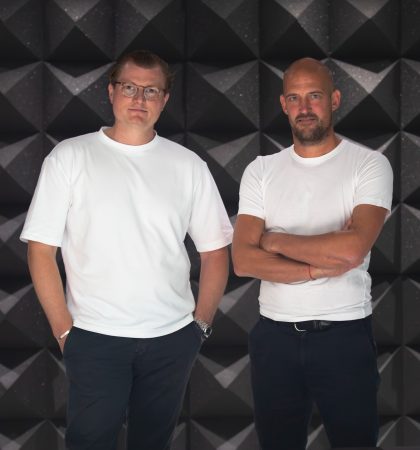
Druid AI has also experienced this trend firsthand as the company has scaled its AI platform across enterprise customers.
“The assumption that growth in output must translate almost directly into growth in headcount. AI has changed that equation: scale now depends less on adding capacity linearly and more on designing clear workflows, decision rights, and escalation paths.
Our AI agents support enterprise environments handling around 100 million conversations a month, so we have had to apply the same discipline internally: automate repeatable work, keep humans close to judgment and accountability, and scale through clarity around roles and responsibilities.” says Andreea Plesea and Raluca Tatarusanu, co-founders of Druid AI.
Why the relationship between growth and headcount is changing
For decades, startups scaled in a predictable way. As revenue grew, so did the amount of work. More customers meant more support tickets, more features to build, more sales conversations, more financial operations, and more internal coordination. The only practical way to increase capacity was to hire more people. Better software made teams more productive, but those gains were incremental. Growth and headcount moved almost in lockstep.
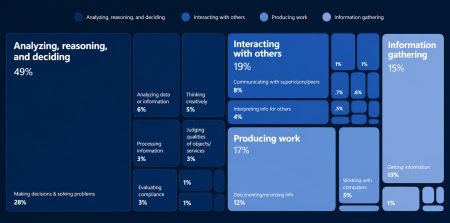
Source: Microsoft Work Trends Index Report 2026
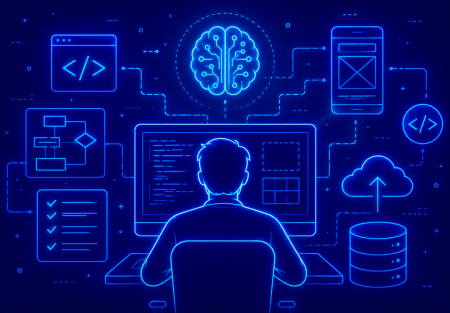
Artificial intelligence changes this equation because it changes who (or what) performs the work. Tasks such as research, coding, documentation, reporting, customer support, content creation, and analysis can increasingly be delegated to AI, allowing one employee to produce significantly more output than before. Capacity is no longer determined solely by the number of people a company employs, but by how effectively people and AI work together.
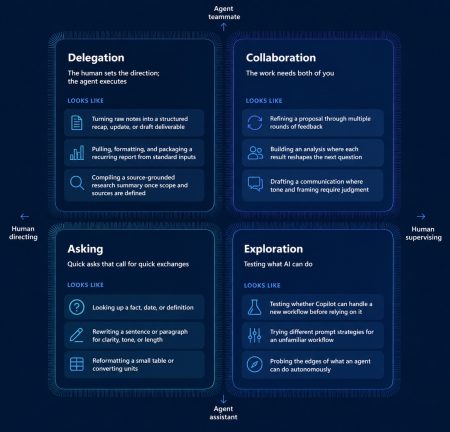
Source: Microsoft Work Trends Index Report 2026
This doesn’t mean companies will stop hiring. In fact, BCG estimates that AI will influence 50–55% of jobs over the next two to three years, while only 10–15% are expected to be replaced over a longer time horizon. As AI augments employees rather than replaces them, organizations can continue growing without expanding headcount at the same historical rate. The connection between growth and hiring becomes weaker because each employee brings substantially more leverage than before.
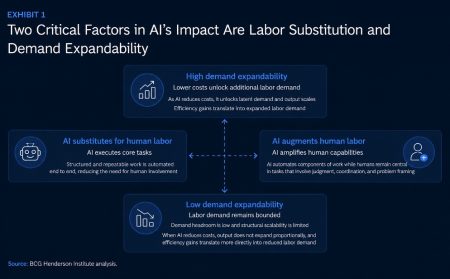
Source: BCG – AI Will Reshape More Jobs Than It Replaces
This is why many experts argue that AI should be viewed as more than another productivity tool. Microsoft’s 2026 Work Trend Index describes AI as the foundation of a new operating model, where humans increasingly direct work while AI agents take on execution. Deloitte draws a similar point, arguing that organizations create the most value when they redesign workflows instead of simply automating existing processes. In other words, AI doesn’t just make companies more efficient; it changes how they are built.
The hiring unit is no longer the job. It is the workflow.
When founders identify a gap in the business, the instinct is usually straightforward: hire someone to fill it. The assumption is simple: every business need maps to a job, and every job maps to a person.
Cosmin Cosma, Co-Founder & CEO, Finqware, says this trend has changed how Finqware approaches hiring:
“We no longer assume that every increase in workload requires another person. We first redesign the work around AI and automation, then assess the capabilities we still need. This does not mean that we stop hiring junior talent. It means that junior roles are changing too. AI can remove some of the repetitive work and help people contribute meaningfully earlier, while giving them more space to learn, experiment, and develop judgment.
The result is not a hiring freeze, but a different hiring bar. We increasingly look for open-minded, curious people who can learn quickly, use technology creatively and grow into broader ownership over time.”
This trend is also changing how Druid AI evaluates whether a new hire is needed in the first place.
“We now plan the hiring much more around outcomes than activity volume. Before adding a role, we look at whether the work should be owned by a person because it requires trust, domain expertise, accountability, or complex decision-making – or whether it should be automated, redesigned, or absorbed into a better process.
This means we hire more deliberately in areas that compound value: solution architecture and delivery, healthcare and financial services expertise, security, senior product, and customer outcome ownership.” — Andreea Plesea and Raluca Tatarusanu, co-founders of Druid AI.
That logic worked when people were the only source of execution. But jobs have never been a single activity; they’ve always been collections of different types of work. A marketer writes content, analyzes performance, coordinates campaigns, communicates with stakeholders, and decides where to invest budget. A software engineer writes code, reviews pull requests, documents systems, researches solutions, collaborates with teammates, and makes architectural decisions.
Some of the activities require judgment. Others are repetitive execution.
AI changes this balance because it can increasingly perform parts of a role without replacing the role itself. Research, documentation, reporting, coding assistance, meeting summaries, customer communication, data analysis, and content generation can all be delegated, accelerated, or completed collaboratively with AI. The remaining work becomes disproportionately centered around decision-making, prioritization, coordination, and context, activities where human judgment still matters most.
This is exactly the transition Deloitte identifies as organizations move from AI experimentation to impact. Many companies fail to realize meaningful value because they simply automate existing processes instead of redesigning them.
At Finqware, that philosophy is reflected in the questions the leadership team asks before creating a new role.
- Is this a durable capability gap or a temporary workload peak?
- Can AI increase the capacity of the existing team?
- What outcome will this person own, not simply what tasks will they perform?
- Does the role require judgment, accountability, customer trust, or regulated-domain expertise?
If we cannot define the uniquely human value of the role, we are probably not ready to open it.” says Cosmin Cosma, Co-Founder & CEO, Finqware
Before opening a new position, the Druid AI team challenges whether the need is truly human or whether the workflow itself should evolve.
“Before opening a role, we ask: What outcome are we buying? Which parts of the work require human ownership? Can an AI agent remove the repetitive layer? And will this role compound over time, or simply add linear capacity?” says Andreea Plesea and Raluca Tatarusanu, co-founders of Druid AI.
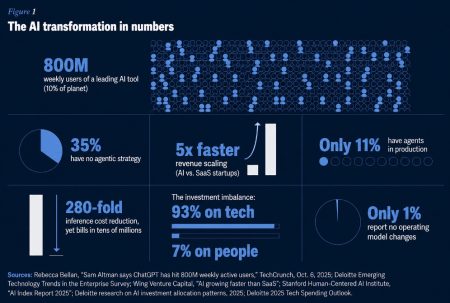
In fact, Gartner also estimates that 40% of agentic AI projects will fail by 2027, not because the technology falls short, but because organizations are trying to automate broken processes rather than rethink how work should flow.
Source: Deloitte Tech Trends 2026
Deloitte also describes the companies seeing the greatest impact as those adopting agent-first process redesign, treating AI as part of the workflow rather than as another software tool layered on top of existing ways of working.
The real scarcity of the workplace – critical thinking
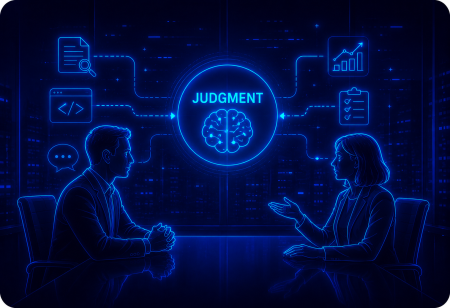
When execution becomes abundant, critical thinking becomes the differentiator. Organizations no longer gain an advantage simply by producing more content or completing tasks faster. They gain an advantage through asking better questions and deciding which work matters most.
AI can generate options, but humans remain responsible for evaluating, applying context, challenging assumptions, and making decisions under uncertainty.
Cosmin Cosma, Co-Founder & CEO, Finqware believes this is exactly where top performers continue to create the most value.
“They understand context and navigate ambiguity, make trade-offs and know when the technically elegant answer is not the right answer for a CFO. They also build trust. They take responsibility when something crosses several teams, challenge assumptions and stay with a problem until the real outcome is delivered.
AI can generate options; our best people know which option matters and are accountable for making it work.”
From Druid AI’s perspective, the distinction between what AI can do and what people must still own is becoming much clearer.
“AI can draft, retrieve, summarize, execute workflows, and surface insights at speed, but it does not carry accountability, build trust with a client’s leadership team, or decide which problem is actually worth solving.” says Andreea Plesea and Raluca Tatarusanu, co-founders of Druid AI.
Agentic AI blurs the traditional boundaries between roles by enabling individuals to perform work that previously required multiple specialists. Microsoft’s 2026 analysis found that as AI assumes more tactical work, the two most valuable human capabilities identified by AI users are quality control of AI outputs and critical thinking, the ability to analyze information objectively and make better judgments. Rather than eliminating human work, AI is increasing the value of human judgment.
Looking ahead, Cosmin Cosma, Co-Founder & CEO, Finqware, believes the competitive advantage will belong to people who know how to work with AI, not simply use it.
“Problem framing, critical thinking, systems thinking and domain expertise have become more valuable. So have prioritisation, clear communication and the ability to verify an answer rather than merely produce one. Curiosity also matters more. The strongest employees continuously redesign how they work instead of treating AI as a faster search engine.”
As AI takes on more execution, Druid AI believes the most valuable human skills are shifting rather than disappearing.
“The skills that matter more are judgment, problem framing, domain depth, customer empathy, and the ability to direct AI agents effectively. Execution is becoming more leverage-driven, with people creating greater impact by combining AI speed with context, quality control, and ownership.”