AI design platforms and vibe coding are changing how digital products are built. Here’s what this means for designers, developers, and startups.
For decades, digital product creation followed a predictable workflow: designers created mockups, developers translated them into code, and product teams managed the handoff between the two. Today, AI-powered design platforms are beginning to turn these stages into a single process.
With the rise of AI-assisted prototyping, code generation, and “vibe coding,” product creation is becoming less about manually crafting interfaces and more about directing intelligent systems to build them. This evolution is changing not only how products are made, but also the roles of designers, developers, and founders.
Going From “Software Engineering” To “Software Direction”
The software industry has gone through several major changes over the past few decades. First came manual coding, where every feature was built from scratch. Then came frameworks, open-source libraries, and cloud infrastructure, which made development faster and more accessible. Low-code and no-code platforms expanded software creation beyond engineering teams. AI is now pushing this evolution one step further.

The difference is that previous tools helped people build software faster. AI helps people decide what to build and generates parts of the implementation itself. As a result, the role of humans is gradually moving from execution to oversight. The most valuable skill is no longer simply writing code or designing interfaces, but directing systems toward the right outcome.
Some industry founders believe this shift is only the beginning. Dusan Omercevic, founder of Codeplain, says that AI may eventually change the primary artifact of software development itself.
“I think we’re starting a transition that will eventually make writing code feel similar to writing assembly today. It won’t disappear, but it will no longer be the primary way most software gets created. Most developers today don’t think in assembly instructions.
They think in higher-level abstractions and let compilers handle the translation. I believe the same shift will happen from code to specifications.”
His prediction is that software teams will focus on defining intent rather than implementations.
“By 2030, specifications, tests, and evaluations will become the primary artifacts of software development for many software domains. In those domains, teams will focus on defining intent, constraints, and expected behavior, while AI systems generate and regenerate implementations. In that world, code becomes an implementation detail rather than an asset that organizations maintain.
The real challenge will no longer be managing codebases, but maintaining clear and coherent specifications that accurately capture what a system is supposed to do.”
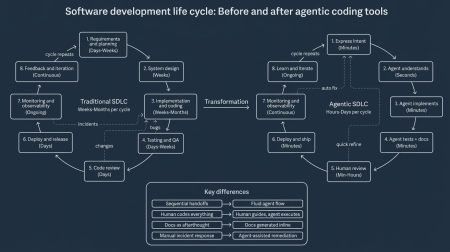
Source: 2026 Agentic Coding Trends Report
As AI becomes more capable, developers spend less time producing code and more time reviewing, refining, and steering AI-generated outputs. In many cases, software creation is becoming a process of iteration and judgment rather than manual production.
1/ The Collapse of the Design-to-Development Handoff
For years, product teams operated through a chain of specialized tasks. Designers produced wireframes and mockups. Developers translated those assets into working software. Product managers coordinated priorities and requirements between both groups.
AI tools are compressing these activities into a single workflow.
A product idea can now move from prompt to prototype to functional application within the same platform. Instead of passing work between departments, teams work around shared AI-generated outputs. The distinction between design tools and development tools becomes less important when both can produce working software.
This does not eliminate collaboration, but it changes its focus. Less time is spent translating work between disciplines. More time is spent evaluating, testing, and improving the product itself.
2/ Design Is Moving from Execution to Taste
As AI lowers the cost of generating interfaces, the value of design goes elsewhere. Creating layouts, screens, and components is becoming easier and faster.
This puts greater emphasis on judgment, product understanding, and user empathy. Two teams may use the same AI tools and receive similar outputs, yet produce very different products based on the decisions they make throughout the process.
In this environment, taste becomes a competitive advantage.
Taste is difficult to define, but it influences countless product decisions: what to simplify, what to prioritize, what to remove, and what to do to create a better user experience. AI can generate possibilities, but it cannot fully determine which direction best supports a company’s goals or users’ needs.
3/ Speed Becomes The New Moat
Historically, companies gained advantages through larger engineering teams, greater resources, or faster execution. AI changes this equation by reducing the effort required to build and test new ideas.
When product creation becomes easier, the bottleneck moves elsewhere.
The companies that benefit most are not necessarily those that generate the most code. They are the ones who learn the fastest. They can launch experiments, gather feedback, identify what works, and adapt before competitors do.
A recent research from McKinsey also signals this pattern. The organizations seeing the greatest value from AI are not using it in isolated tasks. They are scaling AI across multiple workflows, investing in employee training, creating dedicated AI-focused roles, and measuring outcomes across both product and engineering teams.
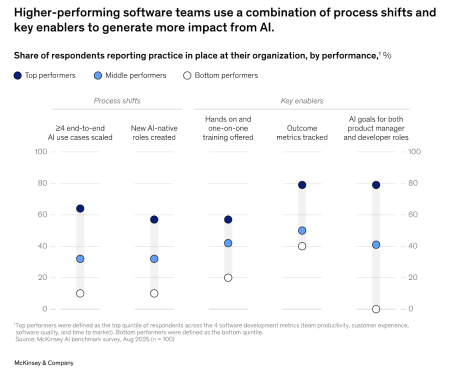
Source: Unlocking the value of AI in software development
AI-Assisted Product Building: What Gets Automated?
AI is becoming exceptionally good at handling structured, repeatable, and predictable tasks. These are the parts of product development that follow established patterns and have clear outputs.
At the same time, AI still struggles with decisions that require business context, trade-off analysis, and long-term thinking.
Project Setup and Scaffolding
One of the most immediate benefits of AI-assisted development is the ability to eliminate setup work. Creating a new application once required configuring frameworks, setting up folders, connecting databases, installing dependencies, and writing boilerplate code before any real product work could begin. Today, AI can generate much of this foundation in minutes.
For startups and small teams, this reduces the time between an idea and a working prototype. Instead of spending days preparing a development environment, teams can start validating product concepts almost immediately.
UI Generation
User interface creation is another area where AI is progressing rapidly. Modern AI tools can generate dashboards, landing pages, forms, navigation systems, and responsive layouts from simple prompts. Instead of manually designing every screen, creators can generate multiple variations and refine the most promising option.
This changes the role of design work. Creating interfaces becomes easier, while evaluating and improving them becomes more important. The challenge shifts from production to selection.
CRUD Applications and Internal Tools
CRUD applications, software built around creating, reading, updating, and deleting data, are particularly well-suited to AI generation.
Many internal tools, admin dashboards, reporting systems, and workflow applications follow familiar patterns. Because these systems rely on predictable structures, AI can generate a large percentage of the required functionality with relatively high accuracy. Businesses can automate operational software that previously required dedicated engineering resources, allowing teams to focus their efforts on customer-facing innovation.
API Integrations
Connecting software services has traditionally been a tedious process involving documentation, authentication flows, data mapping, and repetitive coding.
AI helps developers navigate this complexity. It can generate integration code, suggest implementation patterns, and accelerate the integration of applications with third-party services. While developers still need to validate the output, the amount of manual work required to connect systems continues to decline.
Testing and Debugging
Testing is another area where AI is proving valuable. AI can generate test cases, identify common errors, suggest fixes, and help developers diagnose issues faster. Many developers now use AI as a real-time assistant during debugging, reducing the time spent searching documentation or troubleshooting familiar problems.
Some developers describe the experience as moving from solving every issue manually to working alongside a second pair of eyes that continuously reviews the codebase. This does not eliminate debugging, but it significantly speeds up the process.
What Does Not Get Fully Automated Yet?
While implementation is becoming more automated, areas such as strategy, architecture, security, and user experience continue to rely heavily on human expertise.
- Product Strategy – AI can suggest features, but it cannot determine which problems are worth solving or how a product should compete in the market.
- Architecture Decisions – Choosing the right technical foundations requires balancing current needs with future growth, costs, and complexity.
- Security Reviews – AI can identify common vulnerabilities, but human expertise is still needed to assess risks and protect critical systems.
- Scalability Design – Planning for growth requires understanding usage patterns, infrastructure constraints, and business objectives.
- UX Taste – AI can generate interfaces, but human judgment determines what feels intuitive, differentiated, and aligned with user expectations.
- Complex Debugging – Unusual edge cases and system-wide issues often require investigation and reasoning that AI cannot reliably perform.
- Performance Optimization – Improving speed, efficiency, and resource usage still depends on a deep understanding of how systems behave in production.
This becomes increasingly important as AI-generated software scales. Drawing on his experience building Cleanshelf, Dusan Omercevic points out that maintenance, not implementation, has historically been the real bottleneck.
“The idea for Codeplain came directly from my experience building Cleanshelf, my previous startup, which we sold to SAP LeanIX in 2021. Cleanshelf was an enterprise SaaS management platform, and integrations were at the core of the product. We developed and maintained a large number of integrations, and I kept running into the same problem: the hardest part wasn’t building them, it was keeping them working as APIs, requirements, and dependencies constantly changed. Over time, more effort went into maintaining existing integrations than building new ones.
When AI coding agents became capable of generating software at scale, I realized this challenge was about to become much bigger. If AI can create 10x more code, humans cannot maintain 10x more complexity. While AI can help make code maintenance more efficient, we became interested in a more fundamental question: what if software didn’t need to be maintained in the traditional sense at all?
If implementations can be regenerated from specifications, then specifications become the durable asset, and code becomes disposable. That’s when it clicked for me that specifications should become the source of truth.”
Why the Market Is Growing So Quickly
Software has traditionally been expensive to build because it required specialized talent, long development cycles, and significant upfront investment. AI changes that equation by reducing both the cost and time required to turn an idea into a product.
Across many engineering teams, AI now generates a significant share of production code, with some organizations reporting that between 40% and 80% of code is AI-assisted. This allows teams to move faster, test more ideas, and ship products with fewer resources than was previously possible.
Investors and software buyers are responding to this shift. The vibe coding market, which barely existed a few years ago, is projected to reach approximately $4.7 billion by 2026 and grow at a 38% compound annual growth rate, with forecasts suggesting the category could exceed $37 billion by 2032.
At the same time, the barriers to entry are falling. Founders no longer need large engineering teams to validate ideas. Designers can build prototypes without writing extensive code. Product managers can create working applications instead of static specifications. The ability to build software is expanding beyond traditional development roles.
The new role of product creators
The evolution from traditional product design to AI-assisted product creation is happening faster than many expected.
If we are only looking at three developments from early 2026, we can see how much impact these had on the role of builders. Instead of manually designing every feature, product teams are acting as directors of AI systems that can generate, test, and refine products on their behalf.
The SaaSpocalypse & The Influence of Wall Street
In February 2026, investors took out roughly $285 billion from SaaS company valuations amid fears that AI agents could replace many software products entirely. The event, dubbed the “SaaSpocalypse,” showed us a growing belief that users may no longer need dozens of specialized SaaS tools when AI can generate custom workflows and applications on demand.
The competitive advantage lies in moving from simply building software to designing systems that orchestrate AI agents, proprietary data, and user experiences. In a world where software can be generated dynamically, product strategy becomes more important than product implementation.
From Vibe Coding to Agentic Engineering
A year after popularizing the term “vibe coding,” Andrej Karpathy introduced a new concept: agentic engineering. The idea reflects a fundamental shift in software creation. Instead of prompting AI to generate code snippets, builders now direct teams of AI agents that can plan, write, test, and improve entire systems.
Another trend is taking place alongside agentic engineering: AI systems are moving beyond generating code and toward directly executing work. Microsoft CEO Satya Nadella recently summarized the idea by saying that “every agent needs its own computer.” The implication is that the next generation of AI systems will not simply suggest actions to humans. They will operate inside dedicated environments where they can run code, test outputs, use tools, interact with software, and correct their own mistakes.
This changes the builder’s role once again. Instead of directing a system that generates software, teams direct systems that can autonomously build, test, and improve software.
Y Combinator W25: Proof of AI-Native Product Creation
The strongest validation came from Y Combinator’s Winter 2025 cohort. YC reported that approximately 25% of startups in the batch had codebases that were more than 95% AI-generated.
The significance is not that AI wrote the code. The significance is that investors and startup accelerators accepted these companies as viable businesses despite minimal human-written software.
This suggests that product creation is becoming less constrained by technical execution. Founders can move from idea to working product much faster than before because AI handles much of the implementation work.
As a result, the primary bottlenecks are shifting toward product vision, market understanding, and decision-making. Building is becoming easier; choosing what to build remains difficult.
The Flywheel Behind AI-Native Startups
The strongest evidence for the growth of AI-assisted product building is not the market forecasts. It is the companies already emerging from this trend. Over the past two years, a new generation of AI-native startups has reached revenue and valuation milestones at a pace rarely seen in software.
Lovable, one of the leading players in the category, became one of the fastest-growing software startups ever, surpassing $100 million in annualized revenue within eight months of launch. The platform now enables hundreds of thousands of new projects to be created every day and has become a primary tool for founders, operators, and non-technical builders looking to turn ideas into working products.
Replit reached a $9 billion valuation after transforming itself into an AI-powered application builder, while emerging platforms such as Emergent reportedly reached $100 million ARR in just eight months. Investor interest has followed closely behind, with companies across the vibe-coding ecosystem raising hundreds of millions of dollars and achieving multi-billion-dollar valuations.
Perhaps the clearest example is Anything, a startup focused on helping non-technical users build complete applications through natural language. The company reportedly reached a $2 million annualized run rate within its first two weeks and quickly secured funding at a $100 million valuation.
Why Enterprise Software Is the Next Frontier
Most of the companies attracting attention in the vibe-coding market focus on helping startups, creators, and non-technical users build applications faster. But some of the most valuable opportunities may emerge in enterprise environments, where the challenge is not generating code but understanding context.
This is the thesis behind DesignVerse, a company backed by GapMinder that recently raised a $5.5 million seed round. While most AI development tools focus on accelerating software development, DesignVerse addresses a different problem: helping large organizations generate software that aligns with existing architecture, documentation, design systems, engineering standards, and regulatory requirements.
DesignVerse addresses this through what it calls an AI context layer. Instead of treating software generation as an isolated task, the platform incorporates organizational knowledge, architecture standards, component libraries, and engineering rules into the development process. The goal is to reduce implementation drift and generate software that is aligned with enterprise systems from the beginning.
A similar trend is emerging in developer tooling. Rather than focusing solely on generating code, companies such as Codeplain are exploring how AI can understand the intent, constraints, and context behind software systems. Details about the investment – to be added right after the announcement.
The company’s core argument is that the future of AI-assisted development lies beyond “vibe coding”. As founder, Dusan Omercevic explains:
“Long term, I believe spec-driven development can work for virtually any kind of software. The question isn’t whether software can be generated from specifications. It’s whether you can reliably prove that the generated implementation conforms to those specifications. At Codeplain, we guarantee that generated code fully conforms to the spec, and that becomes increasingly difficult as software complexity grows.
That’s why integrations are such a natural starting point. Individual integrations are usually not very complex. The challenge comes when organizations have dozens or hundreds of them, all affected by changing APIs, business requirements, and external dependencies. The maintenance burden grows quickly, even though the underlying patterns remain remarkably similar. In those environments, treating specifications as the durable asset and regenerating implementations as needed creates tremendous leverage.”
The first generation of tools focused on generating software faster. The next generation is focused on ensuring that generated software remains aligned with organizational requirements, architecture standards, business rules, and regulatory constraints.