
AI is changing GTM strategies. From lower CAC and AI-powered discovery to new GTM roles and investor expectations, explore the data, risks, and 2026 outlook for AI-driven growth teams.
For a long time, scaling go-to-market meant hiring more people. More SDRs to prospect. More sales reps to close. More operations support to keep everything moving. Growth was directly tied to team size, which in turn led to higher burn.
AI has influenced every corner of how a startup grows and scales. They are no longer looking just to add some new tools to their GTM stack. Now, founders and growth leaders are considering redesigning how to generate a qualified pipeline with AI and how new technologies can automate the processes behind it.
We’re no longer questioning whether AI belongs in go-to-market, but rather how well we can embed it into our current processes.
Why Startups Are Using AI in GTM Strategies
The biggest reason is simple: startups want to grow faster with fewer hires. AI can automate lead nurturing, qualification, and even meeting scheduling. That means founders don’t have to build large SDR teams just to fill the top of the funnel. A pipeline can be generated and qualified without increasing headcount at the same pace.
According to recent research, AI sales tools can increase lead generation by up to 50% while cutting operational costs by up to 60%, freeing startups from the need for large SDR teams to fill the top of the funnel. AI is also proving itself in the economics of growth.
CRM systems used to be simple databases. You stored contacts, updated deal stages, and logged calls. Everything had to be entered manually, and the system just “sat there” holding information.
Now, with AI built in, CRMs are becoming active assistants. For example, instead of a rep researching a prospect for 20 minutes before sending an email, an AI agent can scan the company’s website, recent news, LinkedIn activity, and past interactions, then draft a personalized message in seconds. It can automatically score the lead based on fit and behavior and even suggest the best next step, such as booking a demo or sending a case study. The team is no longer manually pushing every deal forward. They’re supervising a system that does much of the prep work for them.
AI is also helping lower customer acquisition costs in very practical ways. Imagine an SDR spending hours each day building prospect lists, writing follow-ups, and updating CRM fields. With AI, much of that work happens automatically. Outreach sequences can adjust based on whether someone opens an email or clicks a link. Meeting scheduling can happen without back-and-forth emails. Lead qualification can run in the background, filtering out poor-fit prospects before a rep ever gets involved.
Across industries, early adopters of AI-driven acquisition techniques have seen customer acquisition costs (CAC) drop by between 20% and 40%, largely due to better targeting, improved lead quality, and automated processes that reduce wasted effort.
So, Is AI Now Required for GTM?
A few years ago, having automation in your go-to-market stack was a little exotic. Today, many investors are looking at how startups grow. If two companies have similar products, but one needs 20 people to generate a pipeline while the other uses AI to do it with 8, the more efficient one usually looks more attractive.
In a recent report from HubSpot – AI in GTM, Adina Tecklu, Partner at Khosla Ventures and other investors, mentioned that “If startups aren’t using AI tools or agents, we’re less inclined to invest.”
At GapMinder, we see the same dynamic playing out in founder discussions. The teams that integrate AI into their GTM early tend to move faster and learn faster. They can test messaging across segments quickly. They can identify which leads convert best. They can personalize demos without spending hours preparing for each one. And importantly, they can do all of this without scaling headcount at the same speed.
This doesn’t mean every startup needs complex autonomous agents from day one. But it does mean that ignoring AI in GTM is becoming harder to justify.
The State of AI in GTM: What the Data Shows Us
Over the past two years, most teams started by “trying” AI, writing emails with ChatGPT, generating LinkedIn posts, and summarizing call notes. But what we’re seeing now is different. It’s influencing how companies get discovered, how they prioritize pipeline, how they forecast revenue, and how they structure their teams.
And the data backs this up. For example, one industry analysis estimates that around 70% of companies report moderate or full adoption of AI in their GTM workflows, with high-growth firms seeing the biggest benefits in efficiency and conversion outcomes.
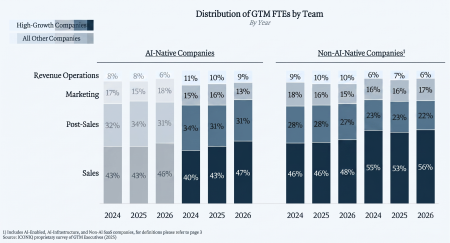
Source: State of GTM in 2025 – ICONIQ
Adoption and Investment Trends
One of the clearest ways AI is now embedded in GTM strategy is through adoption rates. Think about what that means. For years, SEO was the main discovery play.
Now, instead of relying only on classic SEO or outbound channels, teams are asking questions like: “How do we show up inside ChatGPT responses?” and “How do we become the answer in AI search results?”
Across GTM functions, from SDR teams to content and revenue ops, adoption data paints a picture of broad AI integration:
- 47% of companies are experimenting with AI discovery (AEO — Answer Engine Optimization) (source)
- Around 86 % of GTM professionals use AI tools daily in some capacity, and 84 % report productivity gains because of it. (source)
- Large surveys of revenue teams show 68 % of marketing and sales pros use AI at work, with 51 % using AI agents such as automation bots or assistants. (source)
And despite the explosion of new GTM tools, ChatGPT was rated the #1 most impactful GTM tool, with +50% of teams even adapting custom GPTs for specific workflows. So, AI fluency is quickly becoming one of the most valuable GTM skills in 2025. Not just knowing what AI is, but knowing how to apply it inside real revenue processes.
Where AI Is Actually Delivering Results
AI is strongest where work is repetitive, data-heavy, and pattern-based. In other words, anywhere teams are reviewing large volumes of information, running similar workflows over and over, or trying to detect signals hidden in messy data.
Based on research around revenue intelligence and evolving GTM models, marketing teams are seeing the biggest impact. They also have the highest adoption rate, with 30% of marketers using AI compared to just 15% of sales professionals and 6% of customer success professionals.
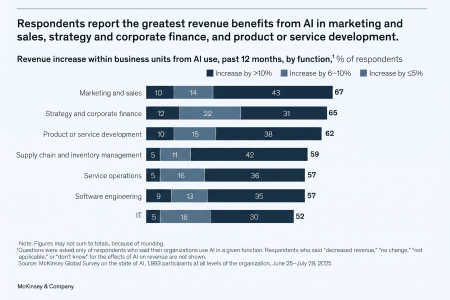
Source: State of AI 2025 – McKinsey
What Disappears and What Emerges in an AI-Driven GTM
Go-to-market teams will not disappear. They will not be completely replaced by AI. But it will reduce the parts of GTM that depend on repetition, gatekeeping, and manual outreach.
For example, traditional demand generation, built around gated content and MQL scoring, becomes less effective when buyers use AI tools to research vendors independently. Influencer-heavy B2B marketing may lose impact as AI systems detect bias and prioritize peer insights over paid endorsements. Classic SEO tactics will be weaker as AI search engines summarize answers directly, rather than sending traffic to vendor websites.
On the sales side, cold-outbound SDR roles are particularly exposed. If AI procurement assistants pre-screen vendors before a human conversation, much of the early qualification disappears. Manual onboarding, basic demos, and Tier 1 customer support will also shrink as AI-powered walkthroughs, self-serve trials, and automated troubleshooting become standard.
At the same time, new roles will grow in importance. Companies will need people who understand how AI-assisted buyers make decisions, AI-driven GTM strategists, revenue intelligence leaders, and workflow designers. Marketing and sales teams will need to prove real business impact, not just generate leads, which increases demand for causal analysis and performance-driven execution.
Community-building and peer validation will matter more, as buyers trust verified user networks over vendor messaging. Customer experience and brand reputation will also become inputs for AI recommendation engines.
How does an AI-powered GTM look? Case-study: Personio
Personio’s CRO, Phil LeCor, helped turn GTM into an AI-powered engine inside an $8.5B company with 400 sales reps and 15,000 customers in just six months. He changed their strategy and how work gets done.
They deployed 400+ AI assistants tied to specific workflows, cut research time from 2 hours to 15 minutes, and had an AI SDR book 140 meetings in just 7 days. They also avoided common mistakes, such as:
- They didn’t run isolated AI experiments in separate teams; they built cross-functional ownership.
- They didn’t expect plug-and-play results. They monitored performance daily and made adjustments fast.
- And most importantly, they built AI around real business context.
Check out the full story below
Market Concerns About AI in GTM
For all the excitement around AI in go-to-market, the reality is more mixed. A big reason? Adoption does not always equal impact.
The State of AI by McKinsey found that while 88% of companies are using AI in at least one business function, only 39% see any measurable impact, meaning more than half of organizations investing in AI aren’t yet realizing clear business value. Similarly, another executive survey found that over 80 % of firms reported no measurable productivity gains from AI so far, despite extensive spending on tools and platforms.
That gap shows up in how teams experience impact:
- High adoption doesn’t guarantee big results. Most organizations are deploying AI tools, but fewer than half report strong or measurable outcomes from those investments.
- Execution still lags. Many teams lack formal governance, clear AI ownership, or governance frameworks, limiting their ability to measure business impact effectively.
- Skills and training gaps matter. Broader workplace surveys show that while large majorities of employees may use AI tools, fewer than a third have formal training.
Expectations for 2026: Where Are We Going?
From now on, it won’t be enough to say “we use AI.” Investors, customers, and GTM leaders will expect AI to drive measurable outcomes, a faster pipeline, lower CAC, higher conversion rates, and better forecasting accuracy.
We’re already seeing this pressure build. Teams that once celebrated small productivity gains will be asked tougher questions: “Did AI reduce sales cycle length?” “Did it improve win rates?” Or “Did it meaningfully lower acquisition cost?”
From now on, it won’t be enough to say “we use AI.” Investors, customers, and GTM leaders will expect AI to drive measurable outcomes, a faster pipeline, lower CAC, higher conversion rates, and better forecasting accuracy.
We’re already seeing this pressure build. Teams that once celebrated small productivity gains will be asked tougher questions: “Did AI reduce sales cycle length?” “Did it improve win rates?” Or “Did it meaningfully lower acquisition cost?”
The GTM model itself is changing.
First, discovery becomes AI-mediated. Buyers increasingly rely on AI tools to research, shortlist, and compare vendors before speaking to sales. That means brand reputation, third-party validation, and structured data matter more than ever. If AI agents are part of the buying journey, you need to be legible to them.
Second, execution becomes system-driven. Instead of scaling headcount linearly, companies will scale intelligent workflows. AI agents will handle qualification, prioritization, forecasting, onboarding, and even expansion triggers. Human teams will focus on strategy, relationships, and complex decision-making.
Third, pricing and trust models will be different. As AI makes vendor comparison easier, differentiation will rely less on messaging and more on proof, proof of ROI, proof of performance, proof of outcomes.