AI makes building software easy, but defending it is harder than ever. Learn how moats are evolving and what it takes to build a lasting AI company.
For a long time, building great software was hard. You needed time, capital, and a strong technical team just to get something off the ground. That friction acted as a natural filter. Fewer products made it to market, and those that did had time to find their footing, improve, and build defensibility.
That’s no longer true. Today, software is more accessible to build than ever.
A small team can ship in weeks what used to take months. AI tools can generate code, design interfaces, write copy, and even help structure entire products. What once required a full organization can now be done by a handful of people, sometimes even a single founder. On the surface, this looks like an advantage. And it is.
But it also creates a new problem. When it becomes easier to build, more people build. More products enter the market. More competitors emerge around the same ideas. And what used to feel differentiated gets commoditized much faster. This is the paradox of AI.
If anyone can build a product, what makes one company defensible over time? What creates an advantage that others can’t easily replicate? In other words, what does a moat look like in the age of AI?
Why moats still matter (even more than before)
As barriers to entry decline, more companies and individuals can create and launch products. This increases the supply of software in the market. As supply increases, competition intensifies. Multiple products begin to address the same use cases, often with similar functionality and performance.
In this environment, differentiation becomes harder to sustain, and products are more likely to converge toward parity over time. This dynamic has direct economic implications. In the absence of a moat, increased competition puts pressure on pricing and margins. Products become more interchangeable, and the ability to capture long-term excess returns becomes less certain. Recent analysis suggests that even established software companies may face shorter periods of sustained competitive advantage in the AI era.
As a result, moats remain the primary mechanism through which companies protect pricing power, maintain margins, and sustain growth over time, despite rising competition.
At the same time, it is important to distinguish between differentiation and defensibility. AI is a strong driver of product differentiation. It can improve performance, expand functionality, and enable new capabilities. However, these advantages are often replicable, especially when underlying technologies are widely accessible.
Defensibility, by contrast, depends on factors that are harder to replicate. These include deep integration into customer workflows, system-of-record positioning, scale advantages, and accumulated data or context. These characteristics tend to emerge over time and are less sensitive to rapid technological diffusion.
In this context, a product can appear highly advanced without being defensible. The long-term value of a company depends less on how impressive its features are and more on whether those features can be easily reproduced by competitors.
If you want to learn more about the importance of moats, we recommend watch this discussion: Why AI Moats Still Matter (And How They’ve Changed)
What has changed about moats in the AI era
Foundation models have turned what used to be a scarce advantage, having the “biggest brain,” into a widely accessible utility. Teams no longer need to train models from scratch or invest millions to reach baseline capability. As a result, relying solely on intelligence is no longer a moat. The competitive dynamic has moved up the stack, from who has the best model to who has the most defensible product.
In this new environment, first-mover advantage is weaker than it used to be. Features that once took years to replicate can now be copied in weeks, or even days. The same tools that let you build quickly also enable competitors to do the same. What used to be differentiation quickly becomes table stakes, and what looks like a product advantage often turns out to be just a temporary lead. This is why many AI products feel interchangeable: they are built on the same underlying capabilities and converge rapidly.
At the same time, the risk surface has expanded. Startups are no longer just competing with each other; they are also competing with the foundation model providers themselves. Companies like OpenAI and Anthropic are launching features and products that overlap with application-layer startups. That creates a constant threat: any successful product category can be absorbed by the platforms it depends on.
Learn more about the opportunities that lie among moats in this era from this: The AI Opportunity that goes beyond Models
The new source of defensibility in AI
The rules of competition in software haven’t disappeared. In a world where anyone can build quickly using the same underlying models, defensibility no longer comes from what you build, but from what you control and compound over time.
The strongest AI companies are not defined by their features, but by the systems they embed into, the data they accumulate, and the habits they create. Moats in this era are less about technical breakthroughs and more about positioning, where you sit in the value chain, how deeply you integrate, and how hard it is for someone else to replace you once you’re there.
Here are some examples of AI moats coming from the world of startups: The 7 Most Powerful Moats For AI Startups
In the sections that follow, we’ll break down the new playbook for defensibility, starting with owning the workflow, then moving through proprietary data and flywheels, distribution and momentum, integration depth, brand and trust, and, finally, speed as an early-stage advantage.
Part one. Owning the workflow
The difference between a feature and a company often comes down to one thing: where the work actually happens. Tools are easy to swap. If your product is just a layer on top, something users visit occasionally, it’s vulnerable. But if your product becomes the place where work lives, switching becomes painful, and that’s where real defensibility begins.
The strongest AI companies embed themselves directly into their users’ daily operations. They become systems of record and systems of action, where tasks are created, decisions are made, and outcomes are tracked. This is what makes workflows powerful: they’re not a single interaction, they’re a continuous loop of activity.
Perplexity illustrates this well. Rather than competing purely on model quality, it built a retrieval-first search workflow with citations and sharing built into the product. The result is a system users return to for ongoing work
AI, in this context, shouldn’t sit on top as a thin assistant. It should be woven into the workflow itself, enhancing it, automating parts, and improving it over time. A chatbot can be replaced overnight. But a deeply embedded workflow system, one that touches multiple steps, integrates across tools, and stores critical context, is much harder to rip out.
Part two. Proprietary Data & Data Flywheels.
Data is often misunderstood as the moat in AI, but that’s only partially true. Raw data by itself isn’t defensible, especially now that models are broadly accessible. What matters is how that data is generated, improved, and used over time.
The most valuable data compounds. It gets better with usage, improves product performance, and creates a feedback loop that competitors can’t easily replicate. But this advantage rarely shows up early. At a small scale, everyone looks similar, same models, similar outputs, comparable performance. It’s only at scale that data advantages become obvious, when one product has learned from millions of interactions while others have not.
Every user interaction should feed back into the product: more usage leads to better data, better data leads to better performance, and better performance drives more usage. Over time, this creates a flywheel that accelerates on its own.
In enterprise settings, data flywheels are already visible. NVIDIA’s internal AI assistant improves continuously through feedback loops, using user interactions to fine-tune models and increase accuracy over time, demonstrating how closed-loop systems compound performance advantages.
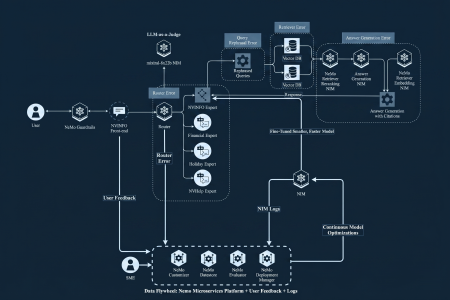
Source: Adaptive Data Flywheel: Applying MAPE Control Loops to AI Agent Improvement
Part three. Distribution & Momentum as a Moat
In slower technology cycles, companies had time to build defensibility before competition arrived. In AI, that window has changed. Markets move fast, products converge quickly, and attention is scarce. In this environment, speed and distribution become critical.
What makes this dynamic unique is that momentum itself becomes a form of defensibility. The faster you ship, the faster you learn. The faster you learn, the better your product becomes. And the better your product becomes, the more users you attract. It’s another kind of flywheel, one driven by iteration and visibility rather than data alone.
ElevenLabs grew by turning product outputs into distribution. Every AI-generated voice clip shared on TikTok or YouTube acted as both content and marketing, allowing the product to spread organically without relying on traditional channels.
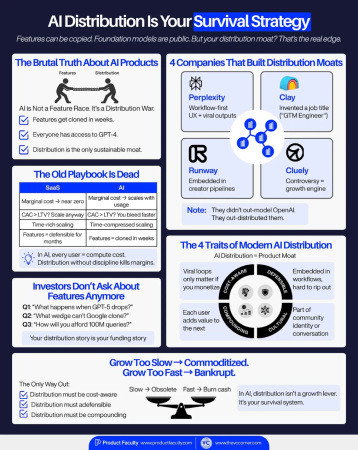
Source: 15 AI Distribution Plays That Build Real Moats!
This is especially true in consumer AI, where behavior is fluid, and loyalty is weak. Users gravitate toward what feels current, useful, and widely adopted. In many cases, the winner isn’t the one with the best product on day one; it’s the one that builds fastest, distributes best, and keeps improving at the highest velocity.
Part four. Integration & Ecosystem Lock-in
One of the most underrated sources of defensibility in AI is integration depth. On the surface, many AI products look similar. But under the hood, the difference between a shallow tool and a durable product often lies in the amount of “unsexy work” that’s been done.
Enterprise environments involve multiple systems, inconsistent data, edge cases, permissions, and legacy infrastructure. Building something that actually works reliably in that context is hard. And most competitors won’t go the distance.
This is where real moats are built. Deep integrations across systems, custom workflows for different customers, and handling all the edge cases that arise in real-world usage create friction for anyone trying to replace you.
Part five. Brand, Trust, and Reliability
In enterprise environments, whether it’s workflows, financial decisions, or customer interactions, reliability matters more than novelty. A slightly better model isn’t enough if it behaves unpredictably.
Over time, companies that earn trust gain an advantage that’s hard to replicate. Users build habits around reliable systems. Enterprises standardize on tools they can depend on. And brand becomes shorthand for consistency and safety. In this sense, brand in AI is the assurance that the product will perform as expected, every time.
Part six. Speed as an Early-Stage Moat.
At the earliest stages, before any of these deeper moats take shape, there’s one advantage that matters above all: speed.
When everything is easy to build, the only way to get ahead is to move faster than everyone else. Faster iteration means faster learning. Faster learning means a better product. And a better product attracts users earlier, giving you a head start.
Data flywheels need usage. Workflow ownership requires adoption. Integration depth takes months or years to build. Speed is what gets you there.
What Doesn’t Work Anymore
If the new game is about defensibility, it’s just as important to understand what no longer holds up. The most obvious example is the rise (and rapid fall) of thin wrappers around APIs. When foundation models became widely available, it was easy to build products that simply packaged existing capabilities into a cleaner interface.
Because those same capabilities are accessible to everyone, these products are easy to replicate and just as easy to replace. When your core value is just a UI on top of someone else’s intelligence, you don’t control the stack, and you don’t control your fate.
Similarly, pure feature-based differentiation has become unreliable. In a world where teams can ship quickly and competitors are watching closely, any useful feature will be copied, often faster than you expect. What looks like innovation quickly becomes standard. This creates a constant race in which no one can pull ahead for long, and differentiation erodes into parity.
Another common mistake is relying on model performance alone as a moat. Having access to a slightly better model, or even building on the latest one, doesn’t create a lasting advantage. Models improve across the board, and what feels like a breakthrough today becomes baseline tomorrow. Intelligence has become a commodity input rather than a defensible asset.
This ties into a broader issue: treating “we use AI” as a strategy. In earlier cycles, adopting a new technology could be enough to stand out. Today, it’s expected. AI is no longer a differentiator; it’s table stakes. The presence of AI in a product says nothing about its durability, just as using the cloud or mobile didn’t guarantee success in previous eras.
What Winning Looks Like in 2026 and Beyond
If the last few years were about proving what AI can do, the next phase is about proving what businesses can sustain. The novelty of AI is wearing off, and with it, the advantage of simply being early or experimental.
From our perspective, these are the signals of a business that can endure. Because at the end of the day, AI is not the advantage. The advantage comes from how AI is applied: how it fits into workflows, how it generates proprietary data, and how it becomes embedded in ways that are difficult to replace.
The metrics follow the same logic. Customer acquisition is not enough to grow quickly; you need to retain users in an environment where switching costs are falling. Retention also becomes a signal of real value. And defensibility becomes a requirement: if your product doesn’t get stronger with usage, it’s unlikely to hold.
Looking ahead, the companies that win in 2026 and beyond will be the ones that build compounding systems, not just impressive demos. They will turn speed into learning, learning into better products, and better products into lasting relationships with users.